Pakistan’s role in the new global system is important, economic stability, political continuity and self-reliance in technology are indispensable, say global experts
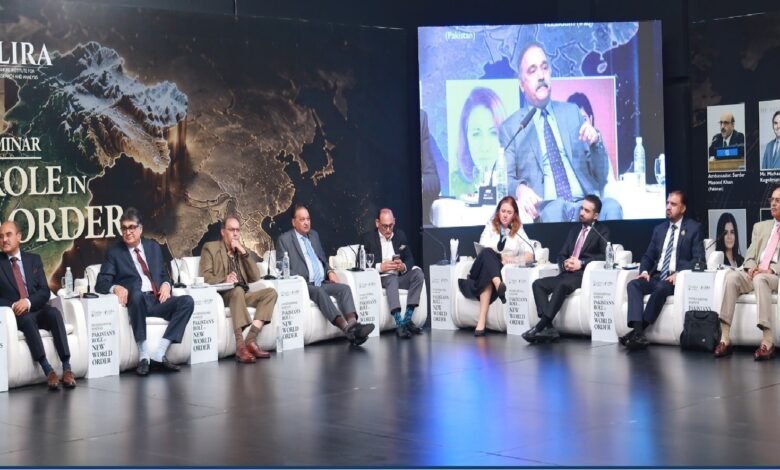
Experts at the International Conference on “The New World Order and Pakistan’s Role” at The University of Lahore Stress Economic Resilience, Political Stability and Investment in Technology

Syed Atif Nadeem-Editor Paksitan
The University of Lahore’s (UOL) Lahore Institute of Research and Analysis (LIRA) organized an international conference titled “Pakistan’s Role in the New World Order”. The conference brought together a distinguished gathering of national and international academic, political, economic and defence experts including former President of Azad Jammu and Kashmir Sardar Masood Khan; former federal minister Fawad Chaudhry; former Federal Secretary and former Principal Secretary to the Prime Minister Fawad Hasan Fawad; renowned scholar and analyst Michael Kugelman; Air Vice Marshal (retd) Sajid Habib; Major General (retd) Zahid Mehmood; educationist Prof. Dr. Sawaira Shami; economist Dr. Khaqan Hassan Najeeb; former CPEC Project Director Dr. Hassan Daud Butt; defence and technology expert Prof. Dr. Nazir Ahmad Malik; educationist Dr. Nadeem Bhatti; Prof. Dr. Zamurd Awan; public policy expert Islam Wazir; international researcher Dr. Rawand Seroon Izzuddin (Iraq); and Dr. Muniba Iftikhar.
The experts shared their views at length on shifting global dynamics, Pakistan’s strategic significance, and the challenges and opportunities confronting the country. The speakers also highlighted Pakistan’s potential for a meaningful role in a changing global landscape and a multipolar world order, and underscored the need to focus on economic stability, political continuity, the promotion of modern technology and the strengthening of national institutions.
Dr. Syed Ragheb Ali, Director General of LIRA, opened the conference by reflecting on the evolving relations among global powers, emerging regional alliances, diplomatic priorities and shifting trends in international politics.
Addressing the conference, former AJK President Sardar Masood Khan said that the world has already entered a multipolar order, and that economically, no single superpower holds complete dominance. He added that sustaining the ceasefire in the Middle East is the responsibility of the international community, and that Pakistan can play an important role in restoring peace and stability in the Gulf region. He also emphasized the need for large-scale investment in modern technology in Pakistan.
Former federal minister Fawad Chaudhry underscored the importance of Pakistan’s geographic and strategic location and its balanced role in the region. He said that the Iran war has placed Pakistan at a highly significant juncture in the Middle East, and that its regional role could further enhance the country’s standing in global diplomacy. He urged Pakistan’s leadership to take effective measures to resolve the challenges facing South Asia.
Renowned scholar and analyst Michael Kugelman also stated that the unipolar world order has come to an end. Commending Pakistan’s policy on the Middle East, he said the country has played its cards wisely. However, he cautioned that without improving its economy, Pakistan would find it difficult to sustain its current global relevance, adding that sustainable economic growth is the foundation of the country’s international standing.
Former Federal Secretary and former Principal Secretary to the Prime Minister Fawad Hassan Fawad highlighted Pakistan’s institutional capacity to contribute to peace and stability in the Middle East, while stressing the need to address the country’s economic difficulties. Lieutenant General (retd) Sikandar Afzal said that Pakistan’s foremost priority should be to make itself economically stable and viable, since the future of any nation is determined by its economic and financial strength.
Air Vice Marshal (retd) Sajid Habib said that the pace at which warfare strategies and methods have changed over the past two years is unprecedented in history. He also highlighted the importance of self-reliance in arms manufacturing and the promotion of indigenous defence production to strengthen Pakistan’s defence capabilities.
Major General (retd) Zahid Mehmood described the Makkah Agreement as the foundation of a new security architecture in the Middle East. He said that Pakistan should maintain good relations with all countries, but without overlooking the interests of its strategic partners.
Prominent educationist and media expert Prof. Dr. Sawaira Shami described youth as Pakistan’s greatest asset and stressed the need to harness their potential fully and invest in them. She also called political stability indispensable for national progress.
Economist Dr. Khaqan Hassan Najeeb highlighted the economic challenges confronting Pakistan, while former ambassador Shahid Masroor Gul Kiani said that, in order to withstand pressure from external powers, Pakistan must first put its own house in order.
Former CPEC Project Director Dr. Hassan Daud Butt emphasized the importance of ease of doing business in promoting foreign investment, and stressed that continuity in government policies is essential to restoring investor confidence. Cybersecurity strategist and defence and technology expert Prof. Dr. Nazir Ahmad Malik pointed to the gap between strategy formulation and implementation in Pakistan. He underlined the need to develop indigenous technology and systems, which would strengthen the country’s technological and strategic capabilities. Educationist Dr. Nadeem Bhatti stressed the need for greater investment in education and research to improve crops and increase agricultural productivity. Czech scholar Dr. Katerina Horakova praised Pakistan’s strong social and community fabric and identified several potential areas of cooperation between Pakistan and the Czech Republic. Associate Professor Dr. Zamurd Awan of Forman Christian College University discussed the various challenges associated with the Makkah Agreement, while communication scholar and journalist Dr. Sundas Mushtaqeem reiterated the importance of a stable economy for Pakistan’s strong standing on the global stage.
Public policy and international development expert Islam Wazir stressed investment in human capital for inclusive national development, particularly the need to provide equal opportunities for progress to people in underdeveloped regions.
Dr. Rawand Seroon Izzuddin, a medical academic and international researcher from Iraq, pointed out similarities between Pakistani and Iraqi cultures and highlighted potential areas of cooperation between the two countries. Communication scholar Dr. Muniba Iftikhar said it is essential to provide the people of Pakistan with proper training across all sectors, so that a skilled, capable and effective workforce can be developed to represent the country more ably around the world.
The conference concluded with a consensus that, in the changing global environment, Pakistan’s geographic location and diplomatic role offer significant opportunities. However, to preserve and strengthen its standing internationally, the country must make economic stability, political continuity, effective institutions, technological self-reliance and human resource development its priorities.